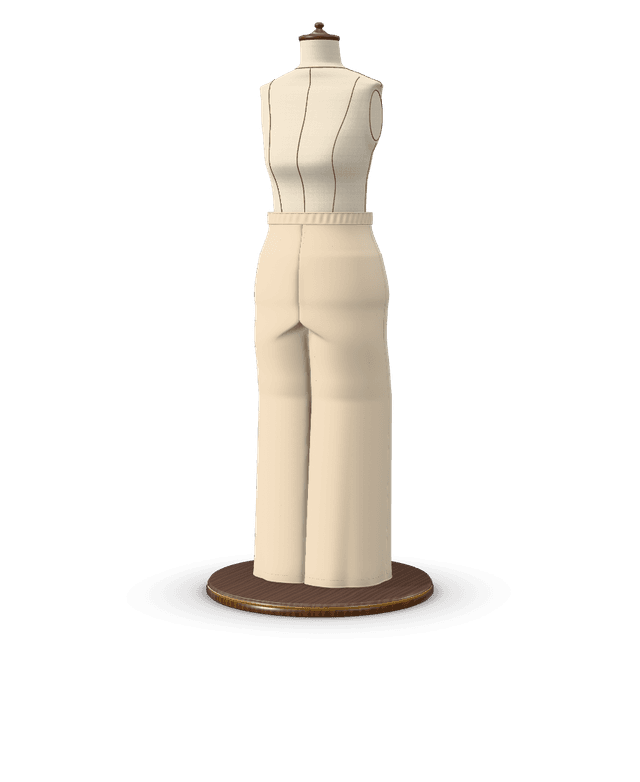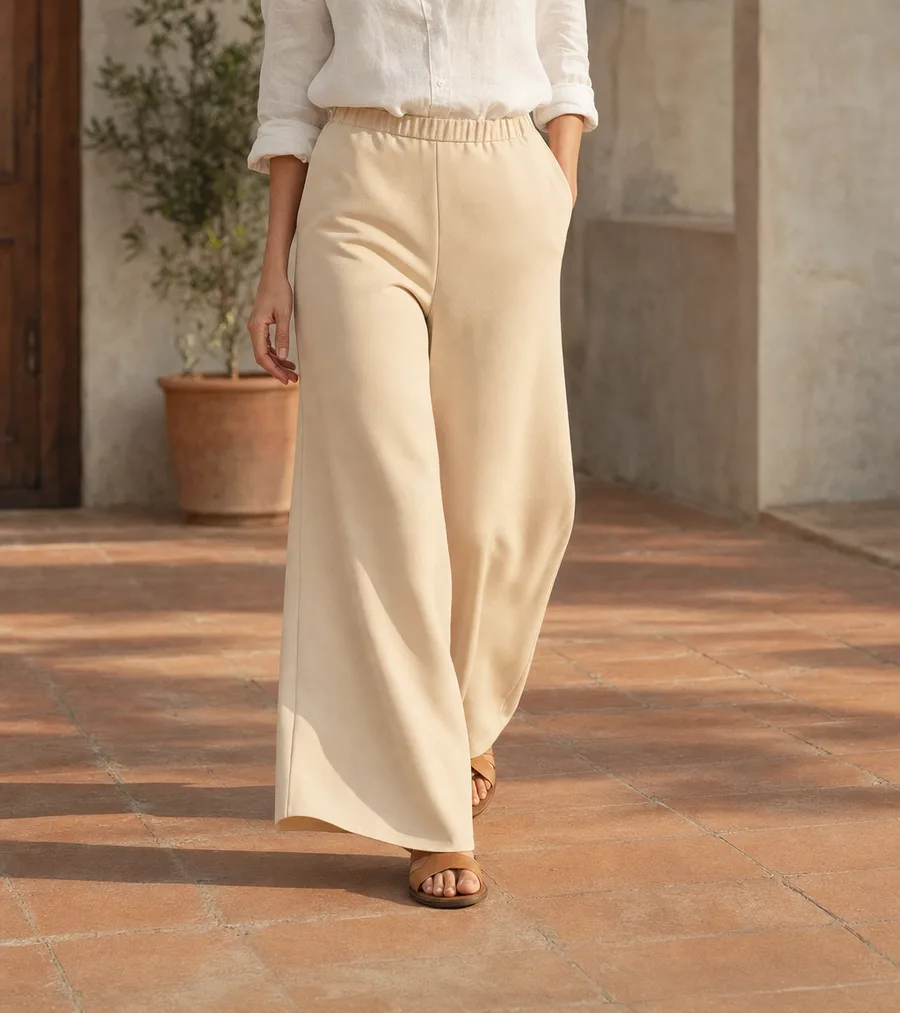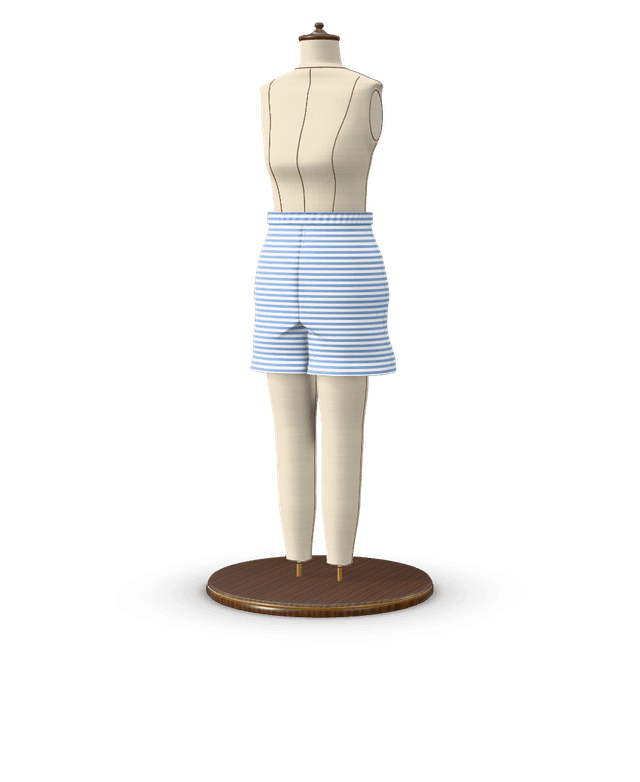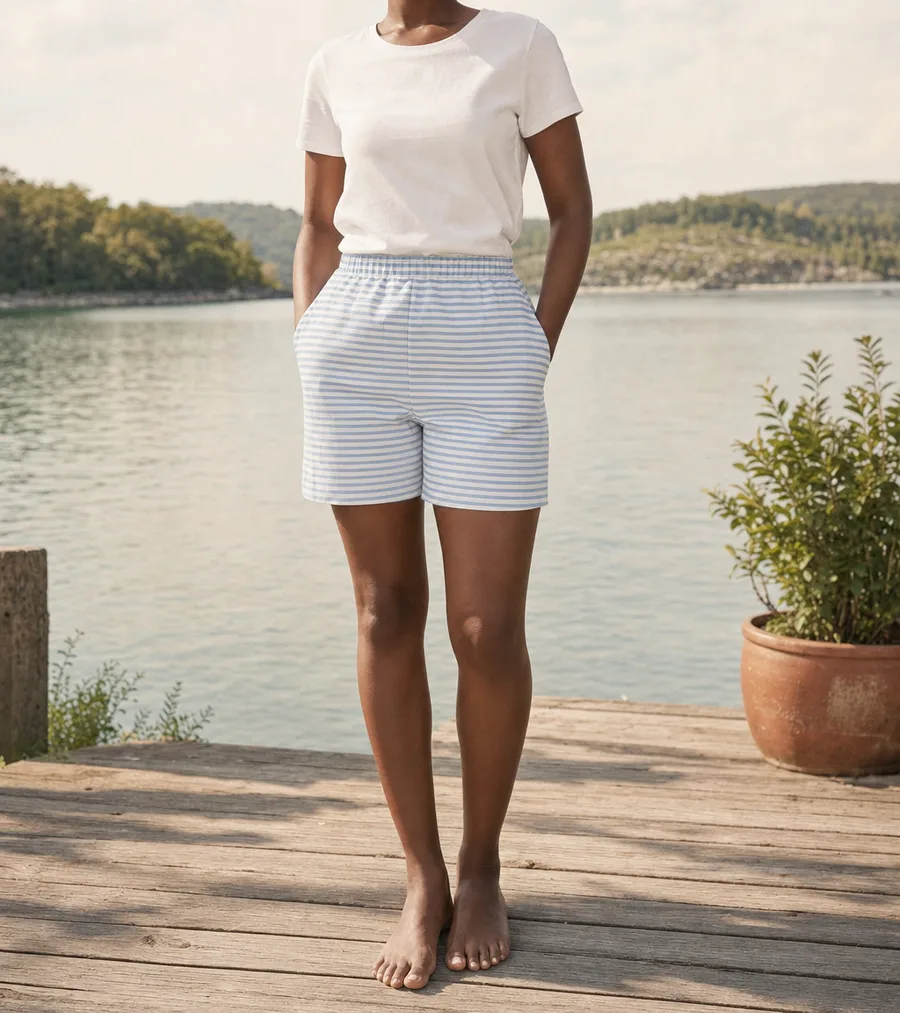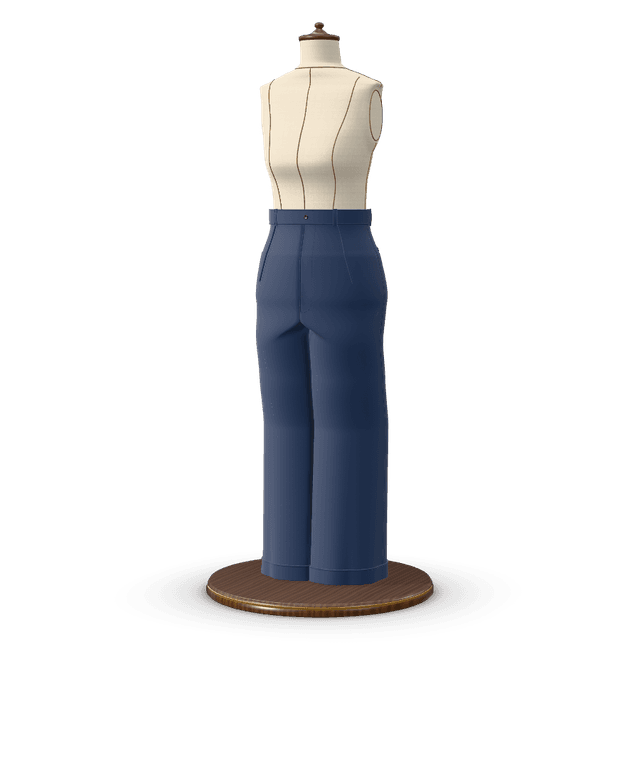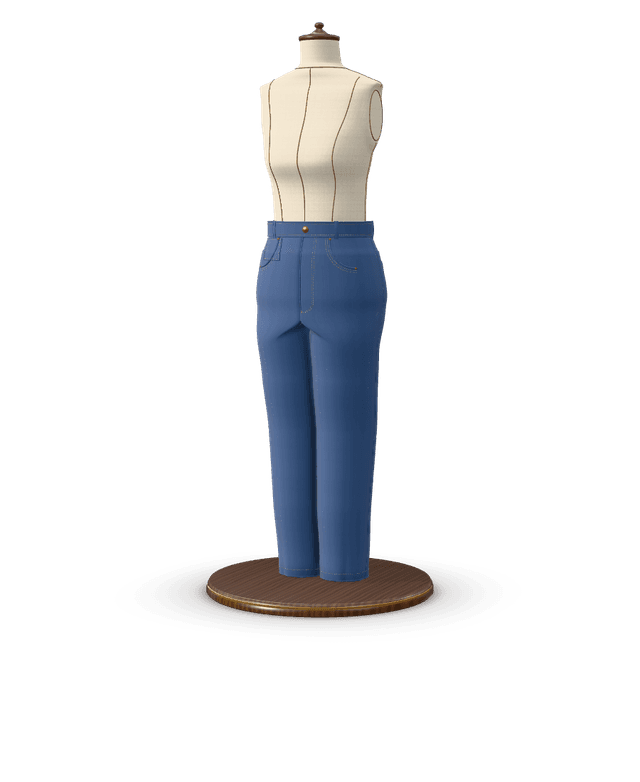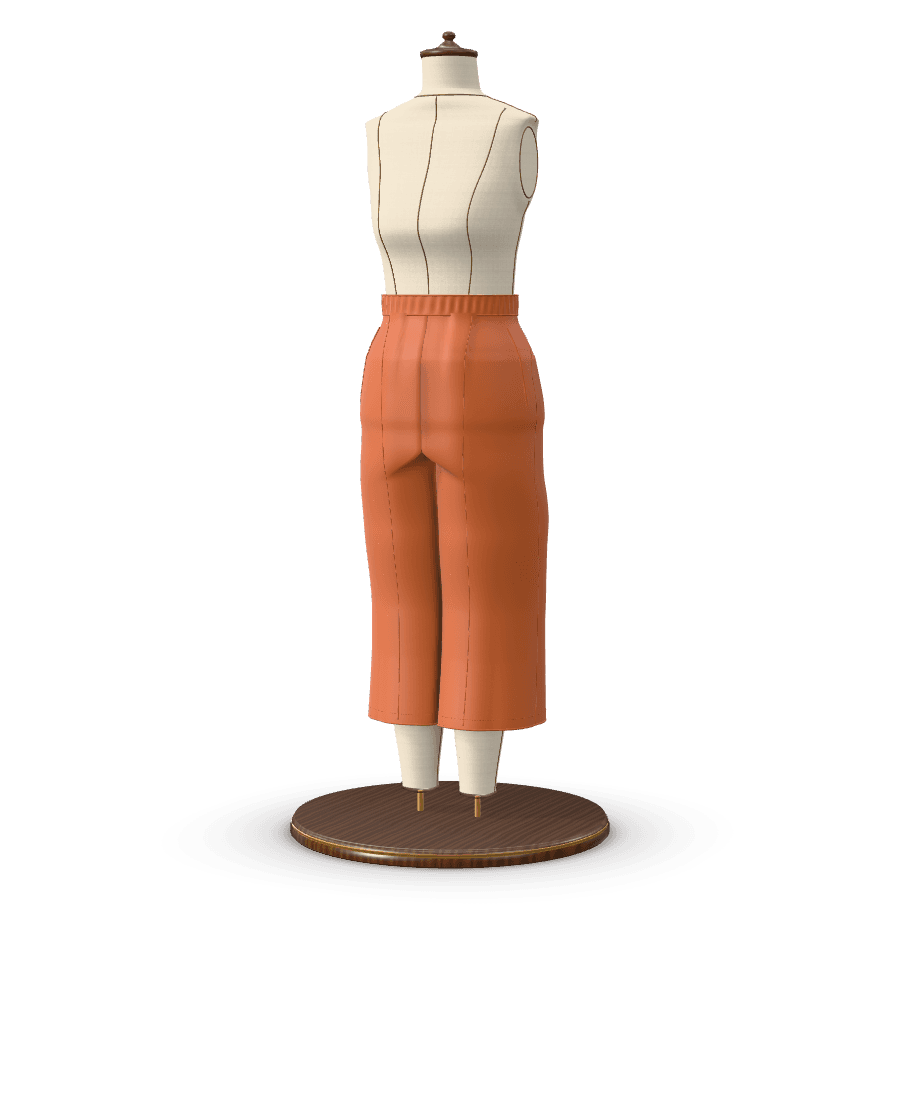
Culottes look like a midi skirt and move like trousers: wide legs cut to mid-calf, a high waist and enough fullness that the two legs read as one when you stand. Ourlette drafts them from a trouser block with your waist, hip and crotch measurements, with a pleat on each front for fullness, an invisible zip in the side seam and pockets hidden in the seams, so there is no fly to sew and nothing to break the line of the front.
Culottes options
Every option redraws the pattern instantly, without using any AI:
- Length: mid-calf (capri) by default; knee or bermuda for shorter culottes, ankle or full for palazzo trousers, with a length adjustment of up to 25 cm (10 in).
- Pleats: one pleat on each front by default, or two, or a flat front.
- Leg: wide by default; straight, flare or barrel.
- Rise and fit: high by default; mid or extra high; regular, fitted, relaxed or oversized, plus extra hip ease.
- Waist and closure: a straight waistband and an invisible side zip by default; a back zip, a faced waist, an elastic or drawstring waist for pull-on culottes; belt loops or a tie belt.
- Pockets: in the side seams by default; slanted, patch or none; welt or patch back pockets.
- Hem: a plain hem by default, or a turn-up or a side slit.
Made to measure or a standard size
Enter your own measurements or start from a standard size: women's EU 32–54 (US 0–22, UK 4–26) or children's 2 to 14 years. Culottes forgive a lot, but the waist and the crotch depth decide whether they sit well; the measuring assistant explains both. Our post on crotch depth vs crotch length tells the two apart.
Best fabrics for culottes
Fabrics with drape, so the legs swing like a skirt: linen, viscose twill, Tencel, crepe, a lightweight wool, cotton poplin for a crisper pair or chambray. Our post on sewing with Tencel covers the slippery ones. Avoid heavy, stiff fabrics, which make culottes look like shorts.
How hard is it to sew?
An easy-to-intermediate project and a good first pair of trousers: there is no fly, the invisible zip sits in a straight side seam, and the pleats are pressed and stitched into the waist seam. Allow four to five hours. Our guide on inserting an invisible zip and our post on how to sew culottes cover the two steps that matter.
What's in the pattern
- Two fronts and two backs
- The waistband
- Four pocket bags
Notions: an invisible zip, with the length given for your size; a hook and bar or a button for the waistband; fusible interfacing for the waistband. The guide lists every piece with its cut count, the notions, the fabric quantity for 110, 140 and 150 cm (45, 55 and 60 in) wide fabric, and a cutting layout; the fabric chart gives every size.
How to sew culottes
- Fuse the interfacing to the waistband and sew the back darts.
- Fold and baste the front pleats at the waist.
- Sew the front crotch seam and the centre back seam.
- Sew the in-seam pockets into the side seams, then the outseams (leaving the zip opening) and the inseams.
- Insert the invisible zip in the left side seam and attach the waistband.
- Hem the legs, finish the waistband closure and press.
For a pull-on pair in jersey or crepe, switch the waist to elastic: our guide on sewing an elastic waistband casing shows how.
Frequently asked questions
How much fabric do I need for culottes?
About 1.7 to 2.2 m (1 7/8 to 2 3/8 yd) of 140 or 150 cm (55 or 60 in) wide fabric depending on the size, and 2.2 m (2 3/8 yd) at 110 cm (45 in) in EU 38; a child's pair takes 0.8 to 1.7 m (7/8 to 1 7/8 yd). Ourlette computes the exact quantity for your size, length and fabric width, with a cutting layout.
What is the difference between culottes and wide-leg trousers?
Length and fullness. Culottes stop between the knee and mid-calf and are cut wide enough to read as a skirt; wide-leg trousers reach the ankle or the floor. The pattern is the same block: set the length to full and you have palazzo trousers, or see the pleated wide-leg trousers with a fly and welt pockets.
Is this culottes pattern free?
Making the pattern, changing every option and measurement, the 3D preview and the sewing guide on screen are free. Your first PDF is free; after that, printing needs a plan, from Library at $2.99 a month (or $29 a year), which prints the whole catalogue.
Can I make culottes from a photo?
Yes. Start from this tested pattern and set the length, pleats, pockets and waist yourself to match your photo, or, on the Maker and Atelier plans, upload the photo or paste a Pinterest or Instagram link, and Ourlette's AI pattern maker drafts the culottes in it from scratch. You can change any option by hand afterwards.