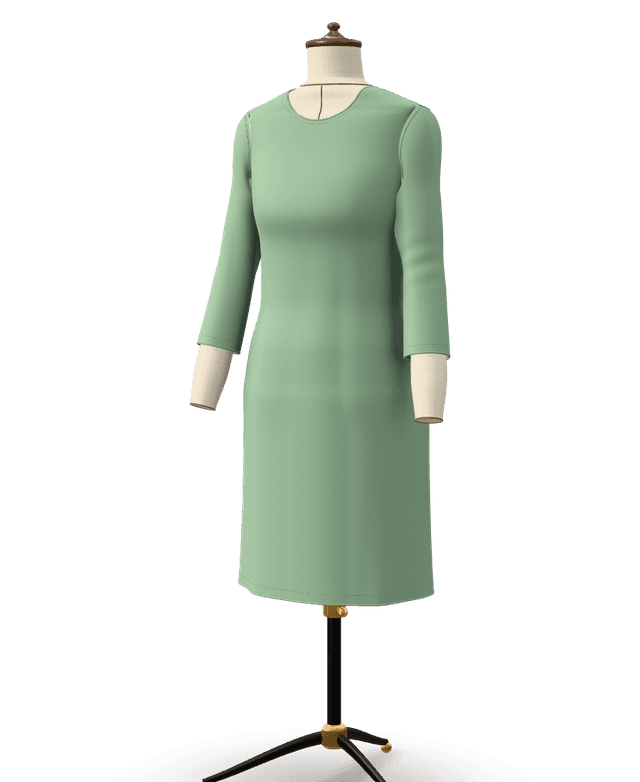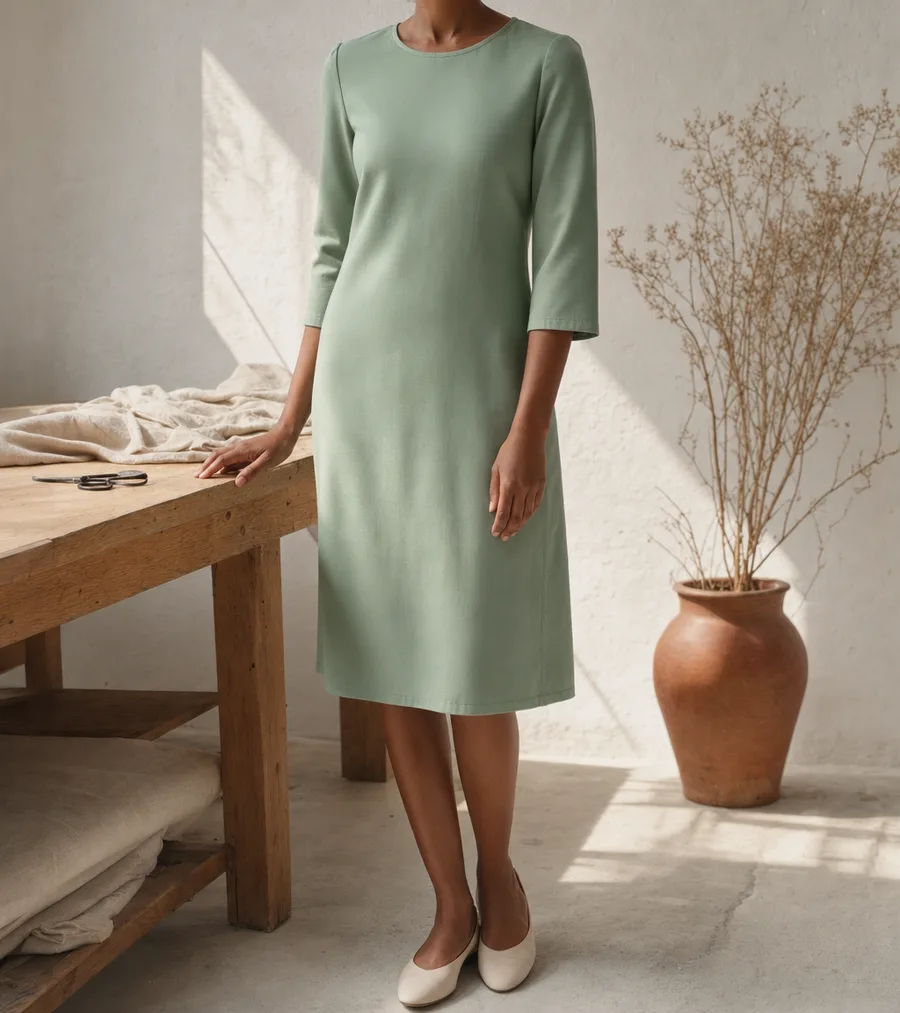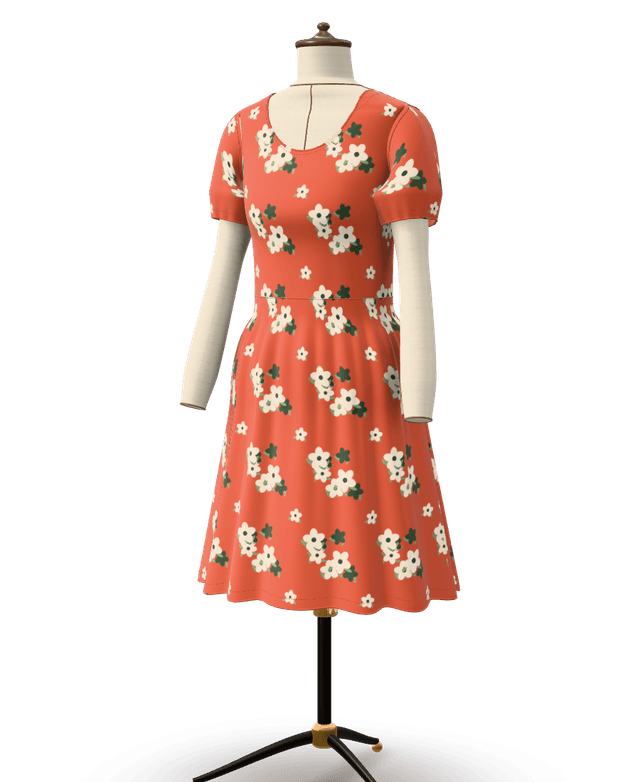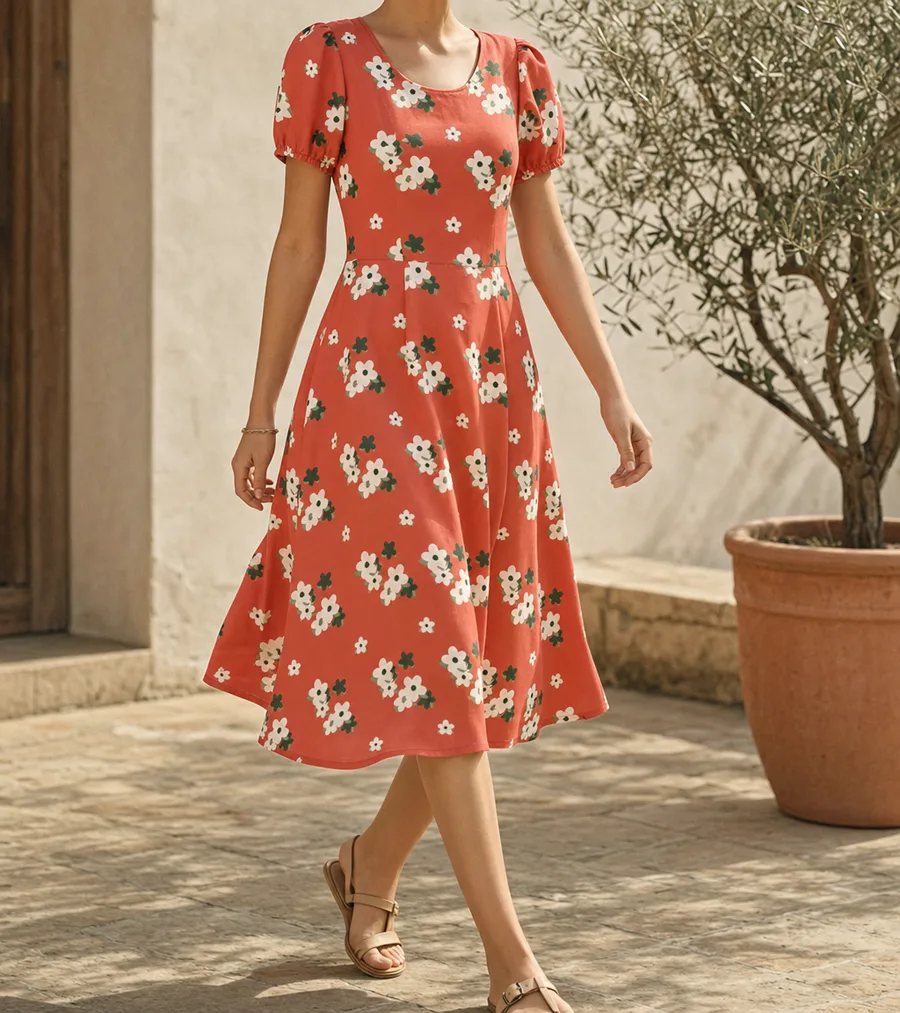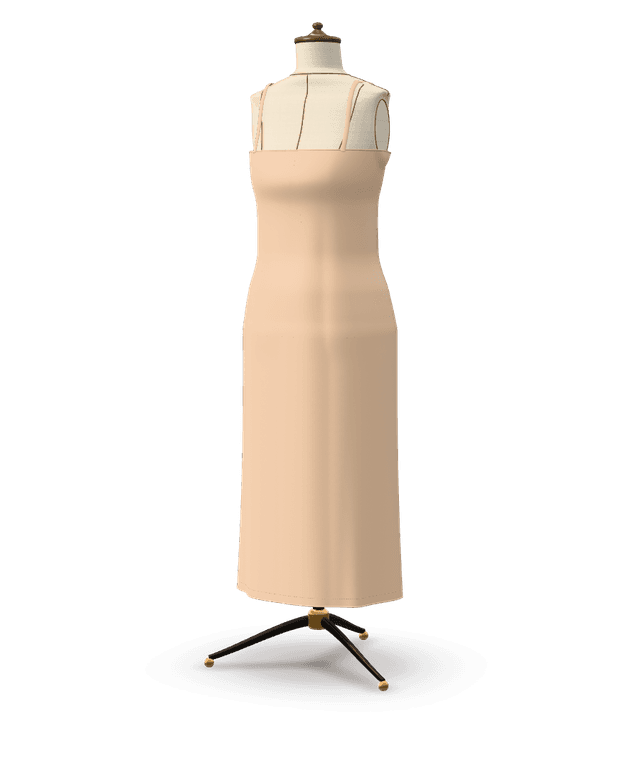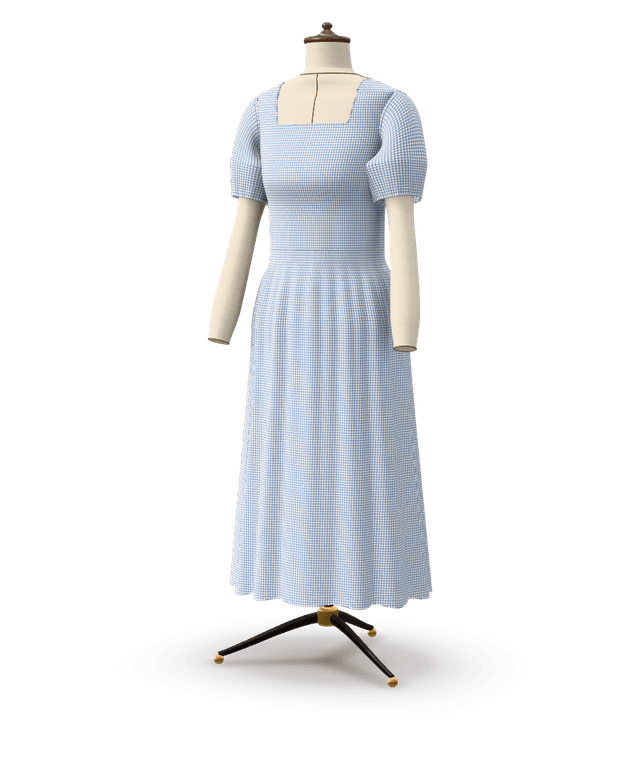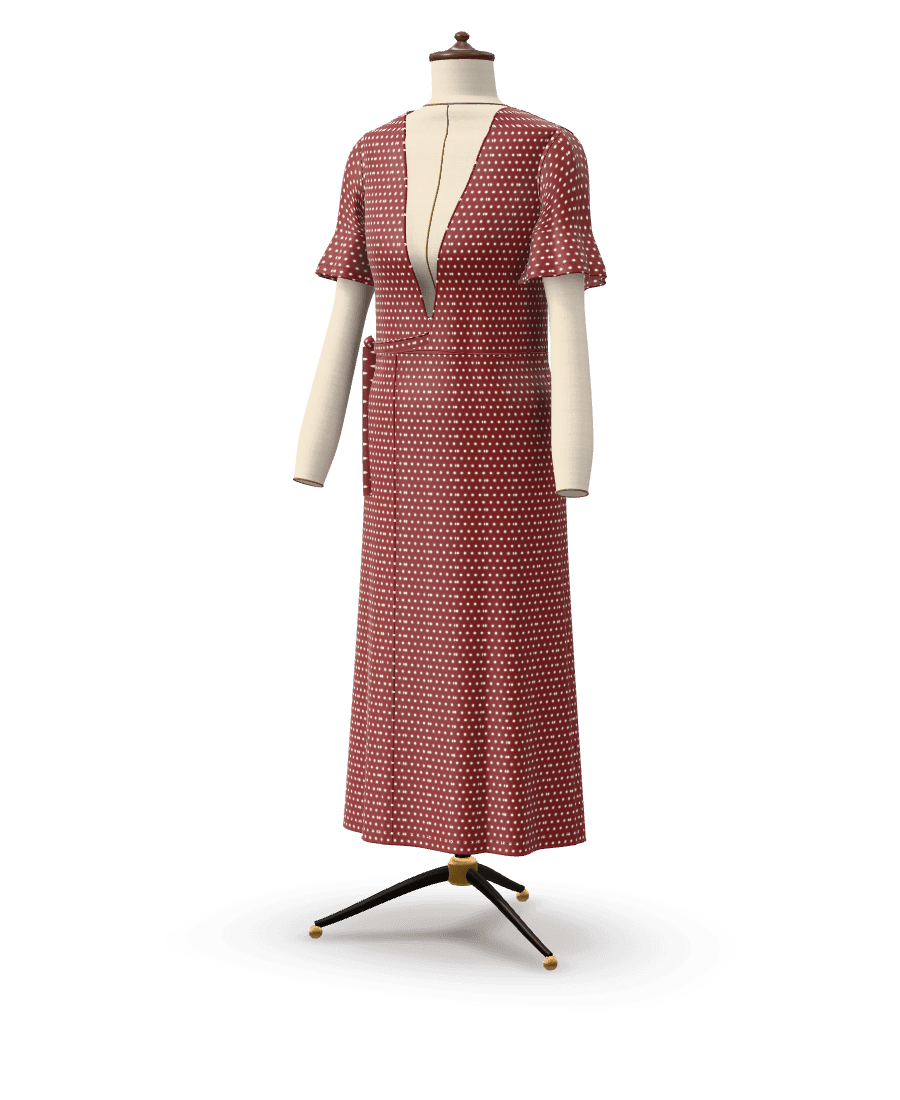
A wrap dress fits almost everyone because it fits itself: the fronts cross over and tie, so the waist adjusts and the V neckline sits where you want it. Ourlette drafts a true wrap, not a faux one with a zip: two bodice fronts with an overlap worked out from your bust, a waist seam, two skirt fronts that wrap with the bodice, long ties through the side seam, and pockets in the skirt seams. In viscose crepe it is the classic 1970s dress; in jersey, the easiest dress you will ever sew.
Wrap dress options
Every option redraws the pattern instantly, without using any AI:
- Sleeves: short flutter (bell) sleeves by default; none, cap, elbow, three-quarter or long; fitted, straight, puff or bishop; set-in, raglan, dropped or kimono.
- Skirt: A-line with 8 cm (3 1/8 in) of flare at each seam by default; straight, pencil, trumpet, half or full circle, gathered, tiered or pleated; 4, 6 or 8 gores.
- Length: midi by default; mini, above the knee, knee or maxi, with a length adjustment of up to 25 cm (10 in).
- Waist seam: at the natural waist by default; empire (under the bust) or dropped (at the high hip).
- Fit: regular by default, or fitted, relaxed or oversized, plus extra bust ease; bust darts are drafted automatically on woven fabric and left out on knits.
- Neckline: the V the wrap forms, raised or lowered by up to 4 cm (1 1/2 in); or a collar on it, from a Peter Pan to a tie collar.
- Pockets and details: in-seam pockets by default, patch pockets or none; a hem ruffle; a separate tie belt.
Made to measure or a standard size
Use your own measurements or a standard women's size, EU 32–54 (US 0–22, UK 4–26). The overlap, the depth of the V and the length of the bodice to the waist all come from your measurements, which is where a graded wrap dress usually gapes or pulls. Our post on how to measure yourself for a dress lists the measurements that matter here.
Best fabrics for a wrap dress
Fabrics that drape and fall close: viscose crepe, rayon challis, Tencel, cotton lawn or silk crepe de chine in woven fabric; a cotton or viscose jersey for a knit wrap dress. Our post on sewing viscose without tears covers the cutting and pressing. Avoid crisp cottons, which hold the wrap open.
How hard is it to sew?
An intermediate project with no zip and no buttons: the care goes into the long faced front edges of the bodice, the wrap edges of the skirt, the waist seam that joins them with the ties, and bust darts on woven fabric. Allow six to eight hours. Our post on how to keep a facing from rolling out and our guide on sewing in-seam pockets cover two of the steps.
What's in the pattern
- Two bodice fronts, cut as a pair, and a bodice back cut on the fold
- Two flutter sleeves
- Two front facings with their interfacing, and a back neck facing
- Two wrap ties
- A skirt back, cut on the fold, and two skirt fronts
- Four pocket bags
Notions: light fusible interfacing; nothing else. The guide lists every piece with its cut count, the fabric quantity for 110, 140 and 150 cm (45, 55 and 60 in) wide fabric, and a cutting layout; the fabric chart gives every size.
How to sew a wrap dress
- Fuse the interfacing to the facings and staystitch the neckline.
- Sew the bust darts (woven fabric), join the shoulders, then sew the front and back neck facings, understitch and turn.
- Sew the bodice side seams, leaving the opening for the tie on one side; sew and set in the sleeves and hem them.
- Sew the skirt darts, the in-seam pockets and the skirt side seams; finish the skirt's wrap edges.
- Make the ties and sew the skirt to the bodice at the waist, catching the ties in the seam at the front edges.
- Hem the skirt with a double fold and press.
Make a toile of the bodice if your bust and waist are far apart: the overlap is the one thing to check.
Frequently asked questions
How much fabric do I need for a wrap dress?
About 2.2 to 3.4 m (2 1/2 to 3 3/4 yd) of 140 or 150 cm (55 or 60 in) wide fabric depending on the size, and 3.3 m (3 5/8 yd) at 110 cm (45 in) in EU 38, at midi length with flutter sleeves; the wrapped skirt fronts take more than a plain skirt. Ourlette computes the exact quantity for your size, length and fabric width, with a cutting layout.
Is this a true wrap or a faux wrap dress?
A true wrap: the bodice fronts and the skirt fronts are separate and cross over, and the dress closes only with its ties through the side seam, so it opens flat and adjusts to your waist. A faux wrap with a fixed overlap and a back zip can be built with the dress builder.
Is this wrap dress pattern free?
Making the pattern, changing every option and measurement, the 3D preview and the sewing guide on screen are free. Your first PDF is free; after that, printing needs a plan, from Library at $2.99 a month (or $29 a year), which prints the whole catalogue.
Can I make a wrap dress from a photo?
Yes. Start from this tested pattern and set the sleeves, skirt, length and neckline yourself to match your photo, or, on the Maker and Atelier plans, upload the photo or paste a Pinterest or Instagram link, and Ourlette's AI pattern maker drafts the dress in it from scratch. You can change any option by hand afterwards.