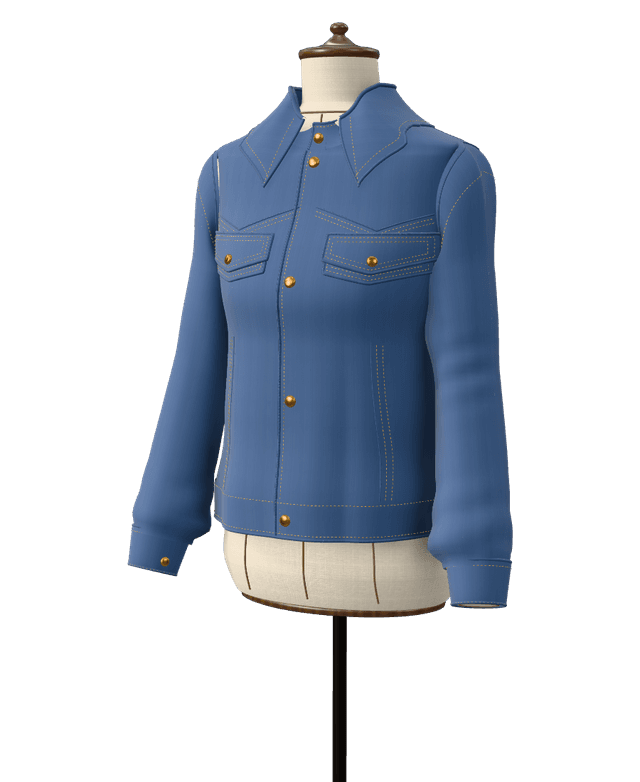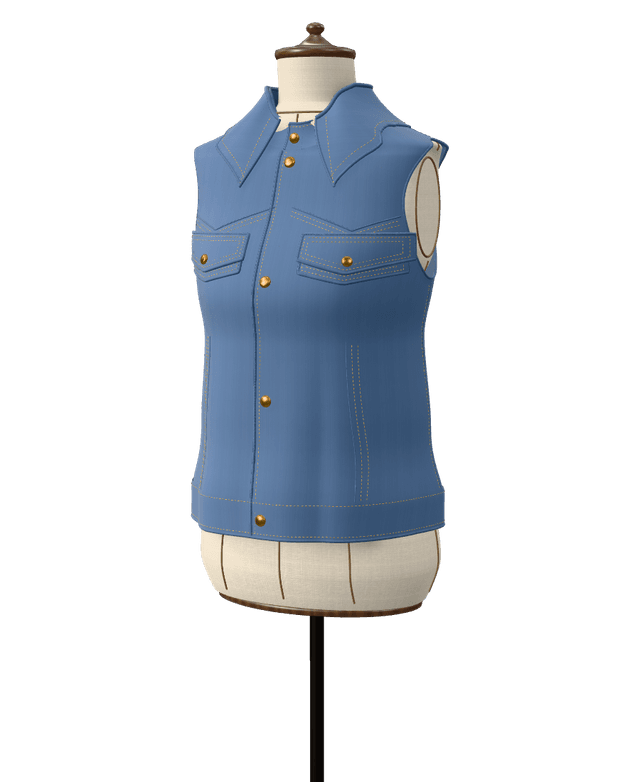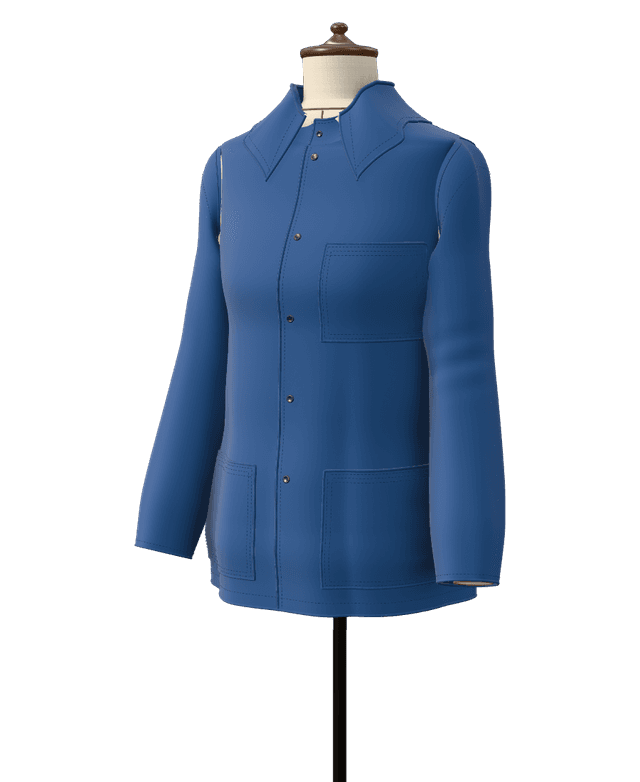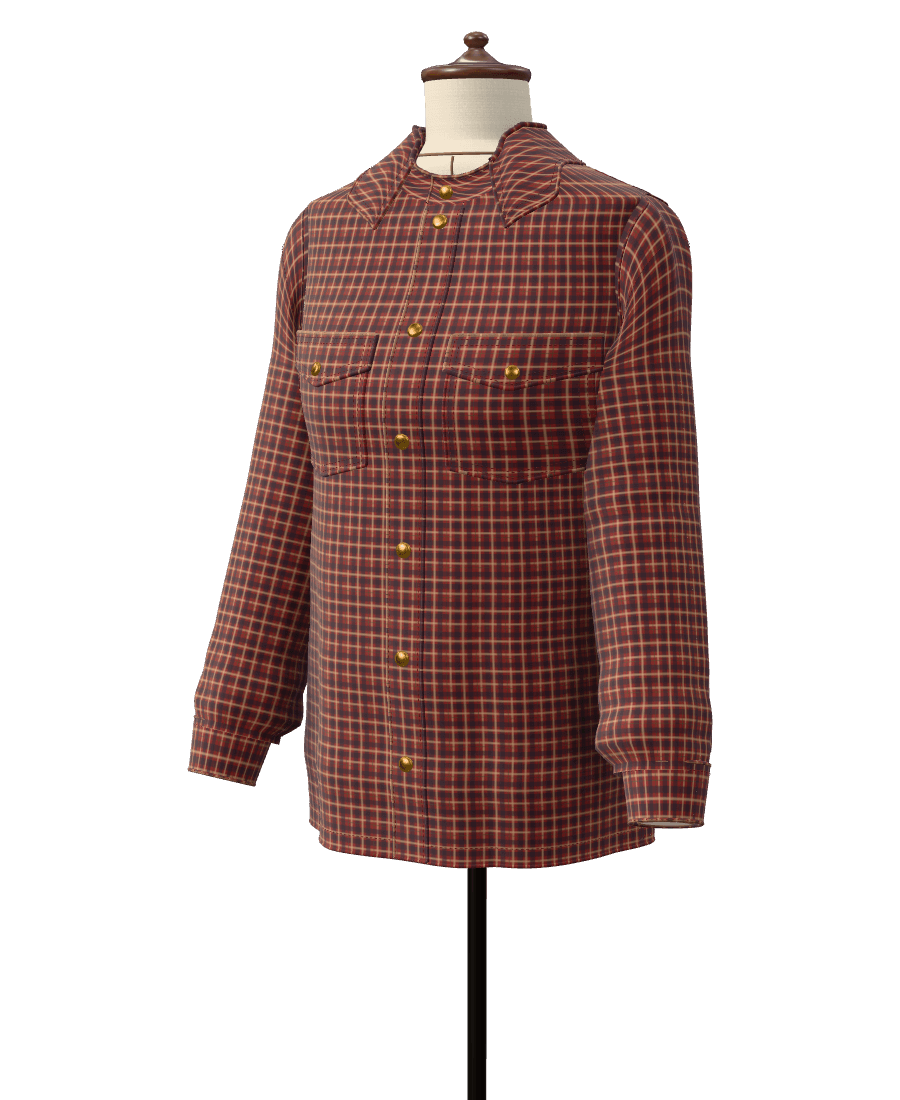
An overshirt is a shirt worn as a jacket: cut roomier, in a heavier fabric, with pockets you can use and a hem that stays out. In wool flannel it is the shacket; in brushed cotton, the lumberjack shirt; in canvas, a light work jacket. Ourlette drafts it from a shirt block with your measurements, a relaxed fit and jacket ease (about 20 cm, or 8 in, at the chest), so it layers over a sweatshirt, with flat-felled seams and topstitching that suit heavy cloth.
Overshirt options
Every option redraws the pattern instantly, without using any AI:
- Pockets: two chest pockets with flaps by default, square, rounded, pointed or angled; add patch or flap pockets at the hips for a field shirt, or welt hand pockets.
- Collar: a collar on a stand by default, with classic, spread, long, rounded or button-down points; a band collar, a camp collar, or a jacket collar on a stand.
- Front: a box placket with buttons by default; snaps, a hidden placket or a faced edge; a zip front.
- Back and sleeves: a straight yoke by default, with an optional pleat; long sleeves with tower plackets and cuffs by default, or band cuffs, roll-up tabs.
- Fit and length: relaxed with jacket ease by default, or regular or oversized, plus extra chest ease; below the seat by default, from hip to thigh, with a length adjustment of up to 25 cm (10 in).
- Hem and finish: straight by default, or a shirttail curve or a band; matching topstitching with flat-felled seams by default, contrast, or none with sewn-on buttons; an optional lining.
Made to measure or a standard size
Use your own measurements or a standard size: women's EU 32–54 (US 0–22, UK 4–26), men's XS to 3XL, or children's 2 to 14 years. The overshirt is cut straight for every body, and the jacket ease is built in: measure as you are, not over a sweater. Our guide on ease in sewing patterns explains how a layering piece is sized.
Best fabrics for an overshirt
Wool flannel, brushed cotton flannel, cotton canvas, moleskin, corduroy, heavy linen or a light wool coating. Medium to heavy weights, 300 to 450 g/m² (9 to 13 oz), hang like a jacket. Our posts on sewing with flannel and sewing with canvas cover shrinkage, needles and the heavy seams.
How hard is it to sew?
A project for a confident sewist who has made a shirt: the same collar, yoke, plackets and cuffs, in a thicker fabric, with flaps and flat-felled seams. Allow 10 to 12 hours. Our post on how to sew a flat-felled seam covers the finish, and the chore jacket pattern is the simpler cousin without a yoke or cuffs.
What's in the pattern
- Two fronts, a back cut on the fold and a back yoke
- Two sleeves, with their tower plackets and underlaps
- Four cuff pieces with interfacing
- Collar and collar stand with their interfacing
- Two chest pockets and four flap pieces
Notions: metal jeans (tack) buttons, 17 mm (11/16 in), or sewn-on buttons if you turn the topstitching off; medium-weight fusible interfacing; topstitching thread; jeans needles 100/16 and a topstitch needle 90/14. The guide lists every piece with its cut count, the notions with their quantities, the fabric quantity for 110, 140 and 150 cm (45, 55 and 60 in) wide fabric, and a cutting layout; the fabric chart gives every size.
How to sew an overshirt
- Fuse the interfacing, set up for topstitching and practice a flat-felled seam on your fabric.
- Fold and stitch the box placket; make the pockets and flaps and topstitch them to the fronts.
- Sew the back yoke, then the shoulders.
- Make the collar and sew it to the neckline between the stand pieces.
- Sew the tower plackets, set the sleeves in flat, fell the side and sleeve seams, and attach the cuffs.
- Hem the body, set the buttons and press.
Thick fabric needs a longer stitch and a lighter presser-foot pressure at the felled seams; test on a folded scrap first.
Frequently asked questions
How much fabric do I need for an overshirt?
About 1.6 to 2.2 m (1 3/4 to 2 3/8 yd) of 140 or 150 cm (55 or 60 in) wide fabric depending on the size, and 2.2 m (2 3/8 yd) at 110 cm (45 in) in EU 38, plus 60 cm (24 in) of interfacing; a plaid to match adds 10 to 20 %. Ourlette computes the exact quantity for your size and fabric width, with a cutting layout.
Overshirt, shacket or chore jacket?
An overshirt is a shirt with jacket ease: shirt collar, yoke, cuffs, chest pockets. A shacket is the same thing in a heavier, often woolly fabric. A chore jacket has a jacket collar, plain hemmed sleeves and three patch pockets, no yoke; see the chore jacket pattern. Both print as your first free PDF.
Is this overshirt pattern free?
Making the pattern, changing every option and measurement, the 3D preview and the sewing guide on screen are free. Your first PDF is free; after that, printing needs a plan, from Library at $2.99 a month (or $29 a year), which prints the whole catalogue.
Can I make an overshirt from a photo?
Yes. Start from this tested pattern and set the pockets, collar, front and length yourself to match your photo, or, on the Maker and Atelier plans, upload the photo or paste a Pinterest or Instagram link, and Ourlette's AI pattern maker drafts the overshirt in it from scratch. You can change any option by hand afterwards.