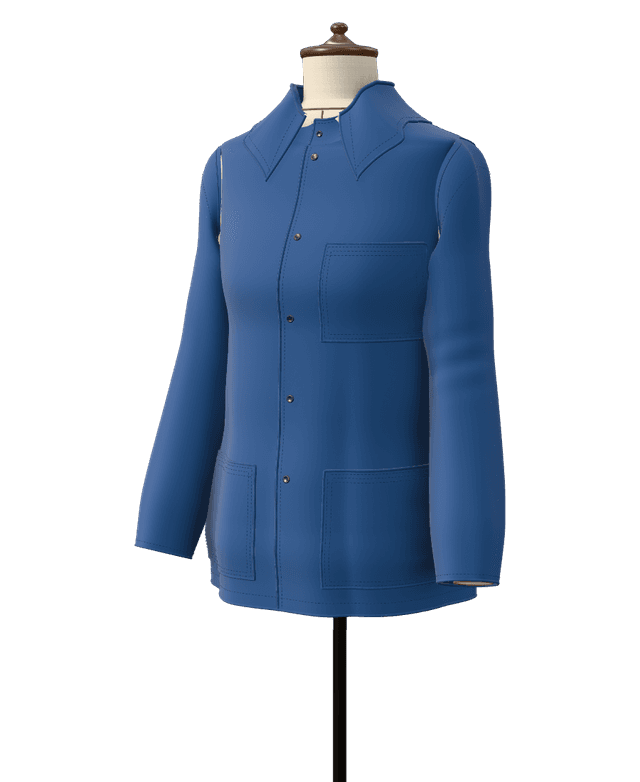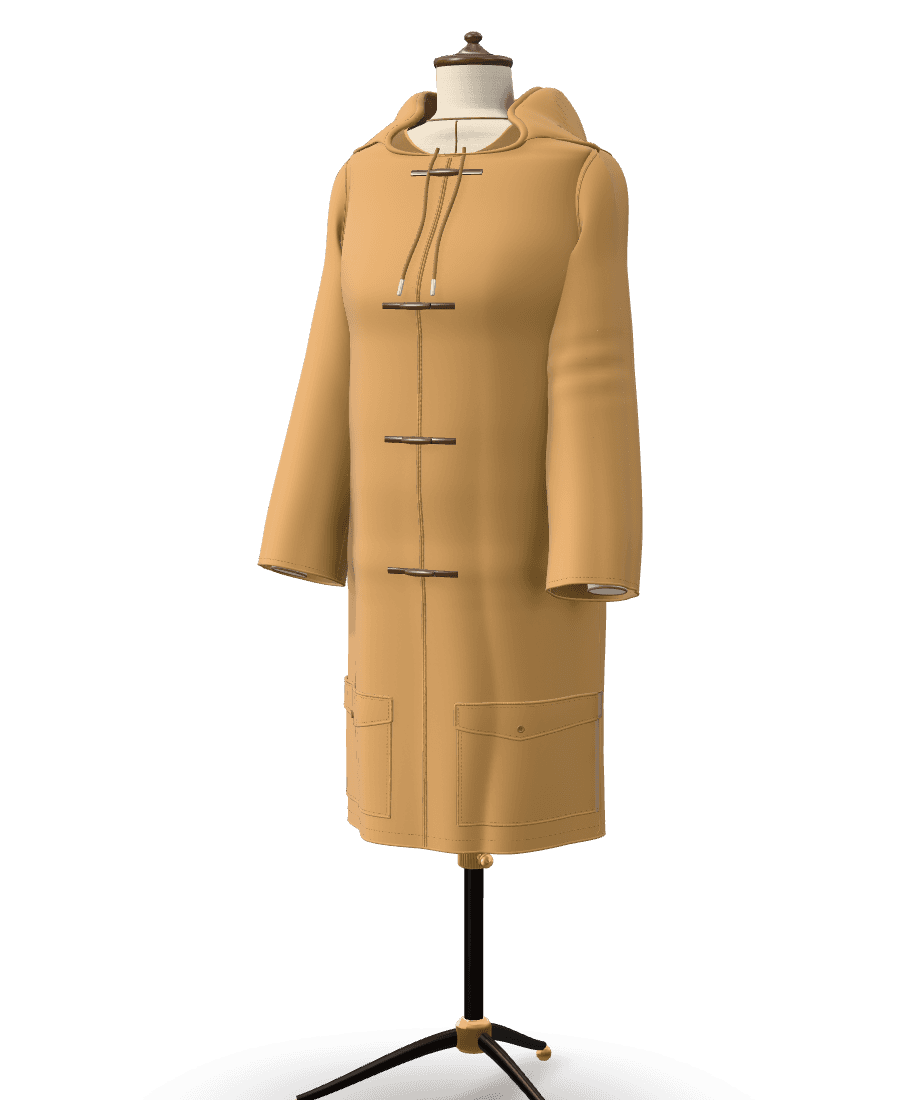
The duffle coat is the hooded wool coat with toggles: the fronts meet edge to edge and close with wooden or horn toggles through cord loops, the hood is lined, and two big patch pockets with flaps keep your hands warm. Ourlette drafts it from a coat block with your measurements and a relaxed fit, with coat ease (about 26 cm, or 10 1/4 in, at the bust or chest) so it goes over a jacket or a thick sweater, and a full lining in body, sleeves and hood.
Duffle coat options
Every option redraws the pattern instantly, without using any AI:
- Toggles: four by default, 45 mm (1 3/4 in), spaced down the front; set the number, or switch to buttons, snaps, frogs or hooks.
- Length: knee by default, from thigh to ankle, with a length adjustment of up to 25 cm (10 in); a thigh-length version is the duffle jacket.
- Hood or collar: a lined hood by default; a jacket collar on a stand, a shirt or a band collar, or a plain neckline.
- Pockets: two patch pockets with flaps by default, with square, rounded, pointed or angled corners and a size from 60 to 150 %; welt or slanted welt pockets instead; add a chest pocket.
- Fit and ease: relaxed by default, or regular or oversized, plus extra chest ease up to 30 cm (12 in) for very thick layers.
- Sleeves: long, set in and hemmed by default; two-piece sleeves that follow the arm, band cuffs, roll-up tabs or shoulder tabs.
- Lining: full by default; turn it off for an unlined wool coat with bound seams.
Made to measure or a standard size
Use your own measurements or a standard size: women's EU 32–54 (US 0–22, UK 4–26), men's XS to 3XL, or children's 2 to 14 years. The coat is cut straight, without darts, for every body. Measure over the clothes you will wear underneath, or let the coat ease do it: our guide on ease in sewing patterns explains the difference.
Best fabrics for a duffle coat
Wool melton or duffle cloth, 500 to 700 g/m² (15 to 20 oz), boiled wool or a wool blend coating; a heavy cotton drill for a lighter version. Line it with a tartan or a plain lining fabric, or flannel for warmth. Our post on sewing with wool covers the needle, the pressing and the bulky seams; how to choose lining fabric helps with the inside.
How hard is it to sew?
A project for an experienced sewist, mostly because of the bulk: thick wool in the hood seams, the faced front edges and the lining bagged in at the hem. There is no collar to set, no zip and no buttonhole except for the pocket flaps; the toggles are sewn on through their loops. Allow 15 to 20 hours. Our post on lined vs unlined garments explains how a bagged lining goes together.
What's in the pattern
- Two fronts, cut as a pair, and a back cut on the fold
- Two sleeves
- The hood, cut as a pair in wool and in lining
- Two patch pockets and four flap pieces
- Two front facings with their interfacing
- Front, back and sleeve linings
Notions: four toggles with their cord loops, 45 mm (1 3/4 in); two buttons, 23 mm (7/8 in), for the pocket flaps; medium-weight fusible interfacing. The guide lists every piece with its cut count, the notions with their quantities, the fabric quantity for 110, 140 and 150 cm (45, 55 and 60 in) wide fabric, the lining separately, and a cutting layout; the fabric chart gives every size.
How to sew a duffle coat
- Fuse the interfacing to the facings and staystitch the neckline.
- Make the flaps, sew the patch pockets to the fronts and the flaps above them.
- Join the shoulders and sew the front facings to the fronts.
- Assemble the hood and its lining, and sew the hood to the neckline.
- Sew the side seams and sleeve seams, set in the sleeves and hem them.
- Assemble the lining, sew it to the facings and the hood, and bag it at the hem.
- Sew on the toggles and their loops, the flap buttons and buttonholes, and press over a ham.
Press each seam as you go with a pressing cloth and steam: wool shapes beautifully but marks easily.
Frequently asked questions
How much fabric do I need for a duffle coat?
An adult duffle coat takes 2.3 to 3.1 m (2 1/2 to 3 3/8 yd) of 140 or 150 cm (55 or 60 in) wide coating depending on the size, about 3 m (3 1/4 yd) at 110 cm (45 in) in EU 38, plus about 2.1 m (2 1/4 yd) of lining and 1.2 m (1 3/8 yd) of interfacing. Ourlette computes the exact quantities for your size, length and fabric width, with a cutting layout.
Can I make it without a lining or without the hood?
Yes. Turn the lining off for an unlined coat (bind the seams, or use a boiled wool that needs no finishing), and replace the hood with a jacket collar on a stand or a plain neckline. A thigh-length duffle without a hood is close to a car coat; see the car coat pattern.
Is this duffle coat pattern free?
Making the pattern, changing every option and measurement, the 3D preview and the sewing guide on screen are free. Your first PDF is free; after that, printing needs a plan, from Library at $2.99 a month (or $29 a year), which prints the whole catalogue.
Can I make a duffle coat from a photo?
Yes. Start from this tested pattern and set the length, the toggles, the pockets and the hood yourself to match your photo, or, on the Maker and Atelier plans, upload the photo or paste a Pinterest or Instagram link, and Ourlette's AI pattern maker drafts the coat in it from scratch. Make a toile of the shoulders and the hood before cutting wool.